Money 2026
I write an essay on personal finance every year or so to leave a trail for myself. The biggest change this year has been moving from managing money as an individual to managing money as a couple.
Time
After Paystack, I took a travel break, spent a lot and didn’t make a dime. The last time I’d gone without a salary was secondary school.
As those months came to an end, the importance of regular income became painfully obvious. No amount of static wealth is enough, and ultimately, the value of money is the ability to control my time.
Before this, I was laissez-faire about money. It’s always come to me. But if I can’t control my time, then none of this is worth it.
And not just that—in taking responsibility for raising a family, my life has become about more than just me. This, as it turns out, is an incredibly effective reason to become more intentional about the hustle.
Family
At first, Princess and I managed money separately.
As we got closer and eventually moved in together, it became unclear who should handle what and where the money for different things should come from. So we decided to have a single pool of money and a single system to run from.
What each of us owned before is still available to the family. But what we’re saving and building now is a together thing. Fresh start.
A few mental models have come to define this era of money for me:
- Don’t depend on lumpy income*
- Predict and prepare for expenses
- Invest as a habit, with no short-term expectations
Reliable income arrives on a schedule and can be planned against. Lumpy income—equity, project work—arrives whenever it arrives.
System
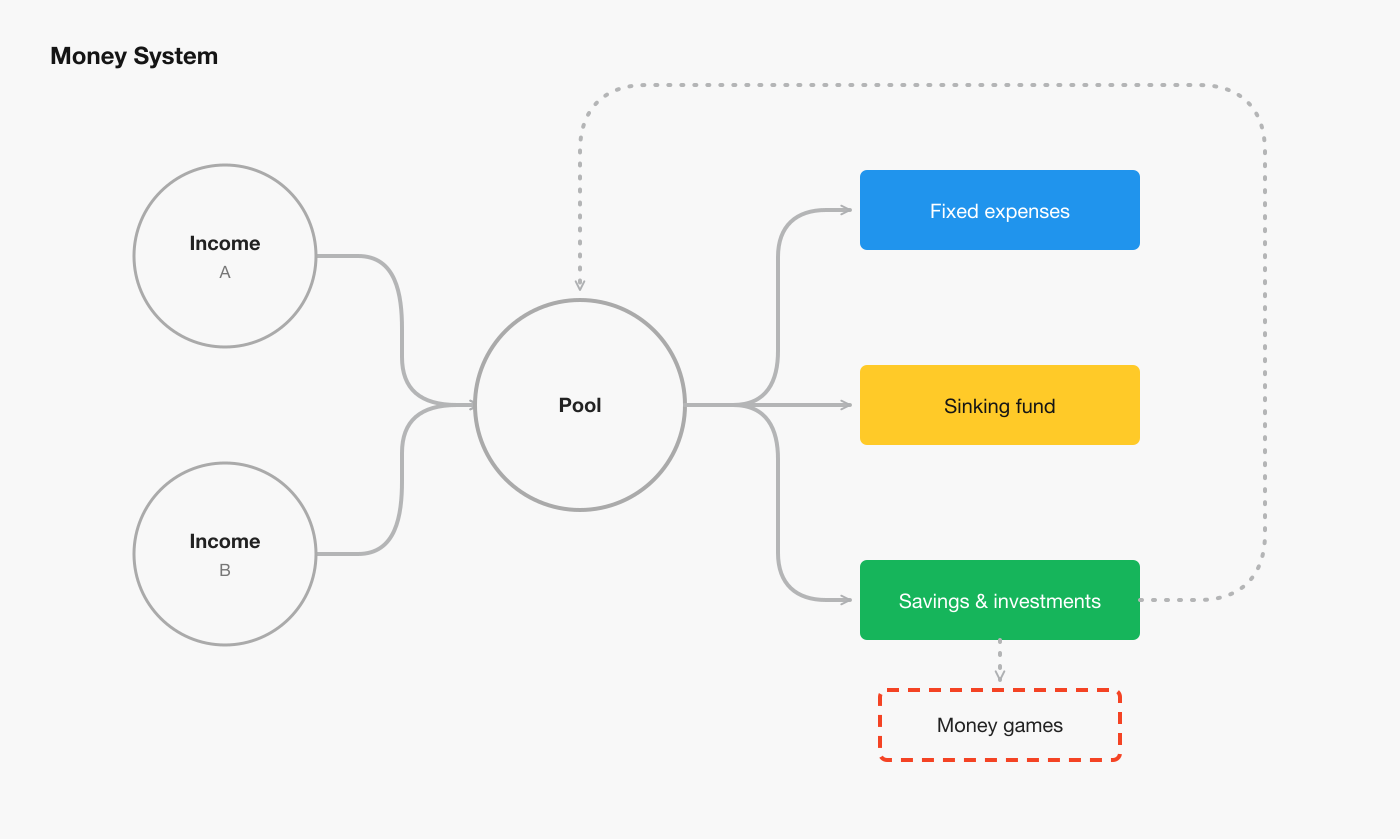
All our income is split into three buckets:
- Fixed expenses
- A sinking fund
- Savings and investments
Fixed expenses
The first bucket is for expenses we expect to happen regularly.
This includes our personal budgets, family support, house expenses, food, groceries and other recurring spending. Everything is earmarked in advance and we review the expenses roughly every quarter.
Each stream of income should be enough to cover this bucket.
Sinking fund
The second bucket is for large, predictable expenses that don’t happen every month: travel, rent, service charges and other one-time payments we can reasonably predict.
Rather than wait for these expenses to arrive, we gradually put money aside for them. The distinction is essentially recurring expenses versus predictable but non-recurring expenses.
The sinking fund turns large future expenses into smaller present ones.
Savings and investments
Historically, I haven’t built my wealth through investing, as most of it has come from equity in things I’ve worked in. So it’s been nice to start thinking about growth as a family.
We invest in pretty much two things: high-yield savings and ETFs.
Essentially, keep money with the best bank and bet broadly on the economy. It’s more about the habit than the returns.
Speculation
Once the three buckets are covered, additional income can go towards more speculative investments or trading.
We’re approaching this playfully, but the process is still deliberate.
First, we find information. We like to understand how people who invest think and what they pay attention to.
Second, we develop a thesis. Whether it’s a stock or crypto project, it’s helpful to lead with a belief system.
Third, we give the thesis time to play out. Time is one of the most important ingredients in wealth-building.
Finally, we automate. Using custom-built software, we can act on our thesis without constant manual intervention: dollar-cost averaging, price triggers and time-based rules.
This is my favorite part because I don’t enjoy watching charts.
This category also includes non-financial speculation, like art.
In summary
Time is the goal. Healthy income is the foundation. We predict expenses and constrain our resources. Savings and investments turn surplus income into wealth. Riskier investing only happens after the other layers are covered, and automation makes it fun.
The point is to protect our way of life. A clear financial system is necessary for alignment, so we can take risks and have more control over how we spend our time.